
We Won’t Go Silently: How noise complaints and other forms of “Culture Policing” contribute to Black displacement in Central Brooklyn
When we went to community events over the summer, we heard from several Central Brooklynites about their memories, concerns and the issues they care about most.
Of course, housing and affordability topped this list. But one more topic came up constantly: the rise in noise complaints and policing targeting the longstanding community events and activities of Black residents.
Events where Black Central Brooklynites gather in public spaces are being more scrutinized by new residents, and the cultural moments we hold dear are being threatened. Many community members said block parties, park gatherings, concerts, cookouts, stoop socializing and other common gatherings are increasingly disrupted by complaints and increased policing.
While each complaint seems like a simple isolated event, analyzed together alongside recent complaints and policing of the annual West Indian Day parade, they are part of a trend of “culture policing” that is directly connected to gentrification, the displacement of Black communities and erasure of Black culture in Central Brooklyn. Liberation News noted in their 2022 article that as newer, predominantly white residents have moved into neighborhoods like Crown Heights over the last decade, complaints regarding neighborhood noise, loitering, and cultural gatherings have increased.
And as many reports have noted, where gentrification comes, increased police activity follows – which can escalate into police and community violence.
Our culture is not a “quality of life” issue.
The gathering of Black communities in public spaces is not random; it's a tool for our survival and a manifestation of our joy.
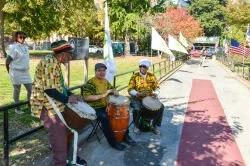
Drummers gather and play in Herbert Von King ( formerly Tompkins) Park in Bed-Stuy. Picture from NYC Parks Dept website.
Black community gatherings matter because they draw on Black resistance and resilience and are vital parts of the Black experience in Central Brooklyn.
Brooklyn became a haven for Black people during slavery as the home to numerous Underground Railroad stations, and then after emancipation, hundreds of freed Blacks fled to Brooklyn to escape racist violence in Manhattan, establishing churches, schools, and mutual aid societies. Later, Black residents established Central Brooklyn as a self-sustaining Black community and a hub for Black homeownership and Black-owned businesses.
The stoops, streets and local parks of Brooklyn became extensions of people’s homes, serving as gathering spaces. Neighbors socialized and created safety by looking out for each other and neighborhood children while convening in front of their homes. Block parties responded to disinvestment, poverty, and displacement and, over time, became a cultural staple, often featuring music, dancing, food, and games that fostered a sense of unity and belonging among residents.
As Caribbean and African immigrants entered Central Brooklyn, their traditions became an integral part of the area's culture. The West Indian Day Parade, which originates from the celebrations of enslaved people in Trinidad, became a Brooklyn staple in the 1970s.
Cultural Policing is not new, and it is intentional.
Cultural policing is another form of “Broken Windows Policing,” a flawed law enforcement strategy focused on aggressively cracking down on minor, low-level quality-of-life offenses to purportedly prevent worse, more violent crimes, particularly in low-income Black and Latino communities. While broken windows policing was widely implemented in NYC during the Giuliani administration, the remnants remain, and activists continue to call for an end to the policy.
As Black communities gentrify, the presence and culture of Black people is commonly questioned and challenged. Data from the New York State Comptroller show that citywide 311 noise complaints reached historic highs in 2024, and Brooklyn has been at the epicenter of this trend.
According to the Community Service Society of New York, “Complaints from newcomers to gentrifying neighborhoods about noise and how public space is used can pose a threat to prevailing notions of community—an attempt to dictate who belongs and how belonging is defined. These complaints can increase police presence, not merely as a consequence of neighborhood change, but as a powerful tool for incoming, affluent residents to redefine how a community operates and regulate access to public space. Police enforcement is thus a critical weapon against community preservation.”
In short, culture policing is a tool gentrifiers use to disrupt longstanding cultural practices, assert cultural dominance over legacy communities, and install new community norms.
What can we do?
New neighbors in legacy Black and Brown neighborhoods must strive to understand the cultural dynamics of where they are moving to, and understand how their actions can contribute to cultural policing.
Get to know your neighbors and start direct, respectful conversations, using de-escalation techniques to resolve complaints.
Remember that sound complaints and other so-called “quality of life” issues reported to 311 may trigger a police response, contributing to the ways that Black, Brown and/or immigrant communities are overpoliced and harmed by police violence.
All of us can help by educating ourselves on the history and meaning of traditions to build understanding, appreciation and respect for the cultures different from our own.
We can support and invest in preserving and honoring Black American, Caribbean, African and Indigenous cultures in Central Brooklyn, including supporting the organizations led by and for our communities.
What is BMC doing?
At BMC, we are working to create more opportunities for conversations and solutions to end cultural policing and the other residual effects of Black displacement in Central Brooklyn. Together, we can organize to build greater community safety and ensure deeper reinvestment in Black communities and organizations.
BMC has also created a basic tracking and reporting tool for Central Brooklyn residents to document instances of cultural policing and build a data source on this issue. Find the tracker at the end of the blog.
Join BMC’s email list to get updates about meetings and events that matter to you, and other ways you can help build Central Brooklyn.
Celebrating Black Joy means protecting our honored cultural practices. We will not be silenced, and we will not be erased.